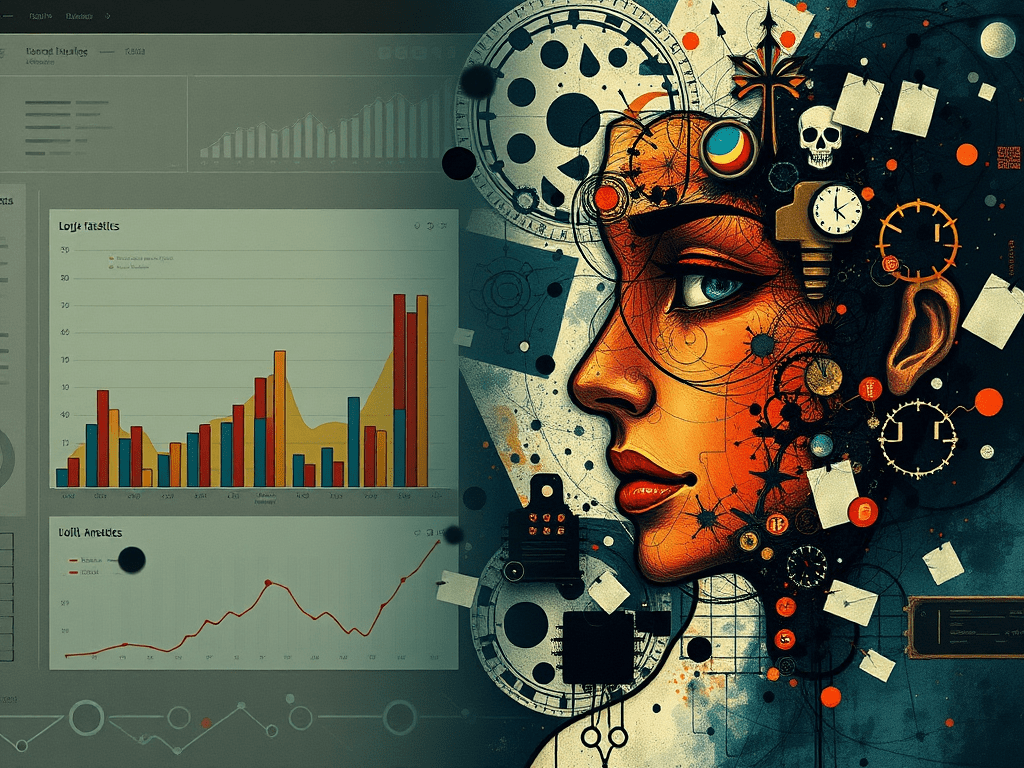
Somewhere along the algorithmic assembly line we decided that “sentiment” was shorthand for the soul. A tidy metric we could chart and optimize until humanity itself looked like a heat map. The dashboards call it insight. I call it taxidermy with better UI.
The Quantification of Feeling
What once belonged to poets and philosophers now belongs to data scientists and brand managers. Emotions are scraped, scored, and sold. Sentiment analysis promises to measure human truth, but really it flattens it. The symphony becomes elevator music.
Marketing loves the illusion of objectivity—emotion without the mess of people. The problem: feelings aren’t stable datasets. They contradict, evolve, and refuse to be neatly labeled “positive” or “negative.” In reducing them to polarity scores, we lose the volatility that makes emotion worth studying.
The Emotional Economy
We live in a marketplace where sentiment trades like currency. Companies mine moods and package them as “consumer insights.” The more emotional you are, the more predictable you become. It’s efficient—and a little horrifying.
Correlation replaces connection. Algorithms notice that sadness and purchase intent rise together and call it empathy. But empathy without context is surveillance with a smile.
The Mechanical Mindset
Enter the mechanistic view of consciousness—the belief that the mind is a machine and the soul a line of code. Every time AI claims to “understand” emotion, we flirt with that idea. It’s seductive: the promise that everything—your heartbreak, your hope—can be modeled, if only the dataset is big enough.
Yet the subjective experience of being alive—the qualia—still resists translation. You can simulate a tear. You can’t feel one.
The soul, if anything, is emergent: not static, not singular, and certainly not reducible to a KPI.
Beyond the Dashboard
Language and metrics betray us here. They trim the wild edges off experience. The most meaningful parts of existence—the quiet, the ache, the transcendent moment—don’t fit inside sentiment tags. What remains unsaid is often the truest thing we have.
In that emptiness, there’s the soul. Not necessarily mysterious—just unmeasurable.
The Ethics of Emotional Surveillance
Sentiment analysis has turned the internet into a psychological panopticon. Every tweet, every sigh disguised as a status update, is fair game for emotional extraction. Consent becomes theoretical when public life requires performance.
If our emotions are to be mined, we need rules. Transparency. Accountability. A reminder that your feelings aren’t open-source data.
Reclaiming the Unquantifiable Self
We are more than the sum of our analytics. The work now is reclamation: creating spaces for unmeasured experience, valuing mystery and contradiction over optimization.
Let the algorithms keep their neat little sentiment scores. We’ll be over here—living in the noise, the nuance, the parts that don’t plot cleanly on a chart.
Post-Mortem Summary
Cause of death: Over-quantification of emotion.
Time of death: When we started believing polarity scores could define humanity.
Contributing factors: Algorithmic hubris, emotional commodification, lack of ethical guardrails.
Findings:
- Sentiment analysis reduces the complexity of emotion into binary categories that erase nuance.
- The emotional economy profits from correlation, not connection.
- The mechanical view of consciousness mistakes simulation for experience.
Lesson learned: The soul doesn’t fit inside a dashboard. Understanding requires context, contradiction, and compassion—three things no metric can automate.
Sources
- Atlas of AI: Power, Politics, and the Planetary Costs of Artificial Intelligence – Kate Crawford, Yale University Press
- The Happiness Industry: How the Government and Big Business Sold Us Well-Being – William Davies, Verso Books
- Data Feminism – Catherine D’Ignazio and Lauren Klein, MIT Press
- The Concept of Mind – Gilbert Ryle, Hutchinson’s University Library (1949)
- The Age of Surveillance Capitalism – Shoshana Zuboff, PublicAffairs



 Measurably Cynical
Leave a comment