
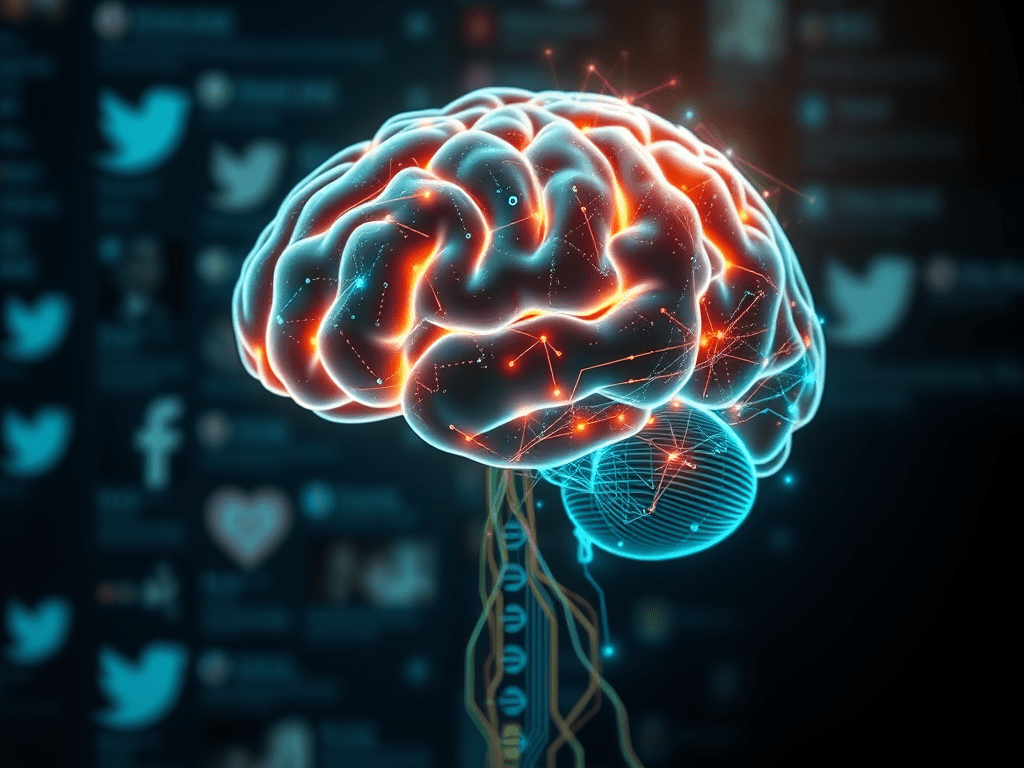
Empathy has long been framed as an art—soft, intuitive, human. But step closer, and it reveals its circuitry. Empathy isn’t just sentiment; it’s signal. It can be mapped, modeled, and, yes, measured.
Algorithms, those blunt instruments of logic, have begun tracing the contours of our compassion. They expose the patterns hidden beneath our instincts. Through data, we find the architecture of empathy—how it flows, where it fractures, and what it reveals about who we are beneath the noise.
Empathy, when seen through a technological lens, stops being merely moral; it becomes structural. And in that revelation, there’s both danger and beauty.
The Paradox of Modern Empathy
We live in the age of connection and emotional distance—an era where empathy is both amplified and anesthetized by the same technology meant to bridge us. Every like, share, and retweet simulates care while siphoning authenticity.
Social media feeds let us scroll through the world’s grief in real time, yet the repetition dulls the nerve endings. Compassion becomes quantifiable—measured in engagement metrics rather than genuine resonance.
Still, data has its uses. It teaches us how empathy moves across networks, where it spikes, and where it flatlines. The question is whether that knowledge helps us feel more deeply—or just simulate the motions better.
True empathy now requires rebellion: choosing presence in an age designed for distraction.
Deconstructing Empathy as an Algorithm
At its core, empathy behaves like a feedback system. One input—recognition of another’s feeling—creates an output: connection or withdrawal. When reinforced, empathy expands. When ignored, it decays.
Understanding this feedback loop gives us power. Not the power to automate empathy, but to notice when the system fails—when defensiveness replaces curiosity, when the loop breaks and leaves silence where care should be.
Empathy, seen as algorithm, is less a mystery and more a method. Learn its loops, and you learn people.
The Dark Elegance of Empathic Precision
Precision empathy—empathy sharpened by data—sounds dystopian, but it might be our saving grace. When wielded ethically, algorithmic analysis refines human intuition rather than replacing it.
AI already practices this in miniature:
- Mental health apps that tailor support based on tone, phrasing, or hesitation.
- Customer service bots trained to sense frustration and respond with calm.
These are imperfect simulations of care, but they’re also prototypes of a future where empathy is not random—it’s intentional, informed, and scalable.
Empathic precision isn’t the death of feeling. It’s the discipline of it.
Literary Mirrors: Fictional Algorithms of the Heart
Long before machine learning, writers were mapping human code. Tolstoy, Morrison, Díaz—all trained neural networks made of prose. Literature has always been the original empathy engine, teaching us how to inhabit other minds.
Modern narratives continue the experiment. The Hate U Give and The Brief Wondrous Life of Oscar Wao don’t just tell stories; they simulate perspective shifts. They run empathy like an operating system—one that patches our biases with every page.
We read to debug our humanity.
The Science of Empathy: Data Behind Emotion
Empathy varies by culture, by generation, by the way we’re taught to see ourselves in others. Studies show collectivist societies sustain higher empathic averages than individualistic ones. Younger generations, raised on digital proximity, score differently again—more global, less patient.
Data doesn’t cheapen empathy. It contextualizes it. We can’t teach compassion at scale without first understanding its distribution.
Artificial Empathy: When Machines Pretend to Feel
Here’s the uncomfortable truth: algorithms are learning to fake empathy better than some humans manage to express it. They read tone, detect sadness, mirror affect—all without ever feeling a thing.
This isn’t horror; it’s design. Artificial empathy could transform care systems, education, even crisis response. But it also invites manipulation. Machines that know when you’re vulnerable can comfort—or sell to—you more effectively.
We stand at the threshold of an ethical divide: use empathy to heal, or to harvest.
Redefining Society Through Empathic Intelligence
Algorithmic empathy could, in theory, rebuild society from the inside out. Policies informed by real emotional data—not assumptions—might finally reflect lived experience.
Imagine governance that responds to actual sentiment rather than poll-tested sound bites. Empathic intelligence applied to policy isn’t sentimental; it’s strategic compassion. A kind of data-driven humanity.
But it demands accountability. Empathy can’t be outsourced to code without consequence.
The Calculated Vulnerability Equation
Game theory meets the human heart: every act of empathy is a risk calculation. Vulnerability is costly; connection is the potential return.
Empathy functions as a strategic exchange. Too much exposure invites harm; too little yields isolation. The art lies in recognizing when to open the gates—and when to keep them guarded.
In that calculus lives the possibility of real intimacy.
Embracing the Algorithmic Heart
This is the strange future we’ve built: machines trying to feel, and humans trying to remember how. The algorithmic heart isn’t a contradiction—it’s a mirror.
Our empathy, filtered through data, might yet evolve into something stronger. Not artificial, but amplified. Not mechanical, but measurable.
If we learn to read our own emotional code with as much curiosity as we read everyone else’s data, we might finally design what humanity has always promised itself—a world both intelligent and kind.
Sources
Policy / Regulation (EU AI Act)
- Official text: Regulation (EU) 2024/1689 (Artificial Intelligence Act), Official Journal of the EU.
- Prohibited practices overview (Article 5, readable): AI Act Explorer.
Legislative background (Parliament “Legislative Train”)
Emotion-Recognition / “Emotional AI”
- Feature analysis: The Guardian — “Are you 80% angry and 2% sad? Why ‘emotional AI’ is fraught with problems.”
Social Media, Doomscrolling, and Empathy
- Peer-reviewed scale & correlates: Satici, S. A., et al. (2022). “Doomscrolling Scale: Associations with personality, FoMO, and distress.” Frontiers/PMC.
- Cross-cultural mental-health impacts: Shabahang, R., et al. (2024). “Doomscrolling evokes existential anxiety and fosters misanthropy.” Computers in Human Behavior Reports.
- Clinically oriented explainer: Harvard Health Publishing (2024). “Doomscrolling dangers.”
Compassion Fatigue / Digital Empathy
- Healthcare lens on AI & compassion: Morrow, E., et al. (2023). “Artificial intelligence technologies and compassion in healthcare.” Frontiers in Psychology.
- Conceptual critique of mediated “empathy machines”: Sora-Domenjó, C. (2022). “Disrupting the ‘empathy machine’.” Frontiers in Psychology.
- General review of compassion-fatigue signs: Stoewen, D. L. (2020). “Signs and consequences of compassion fatigue.” The Canadian Veterinary Journal/PMC.
AI-for-Mental-Health (Evidence of benefit)
- Fitzpatrick, K. K., Darcy, A., & Vierhile, M. (2017). “Woebot RCT for depression/anxiety in young adults.” JMIR Mental Health.




 Measurably Cynical
Leave a comment